Search Enterprise or @FordOnline
Please remove special characters

Ford's Top Safety Engineering Expert Honored With National Award for Lifesaving Innovations

Oct 09, 2026


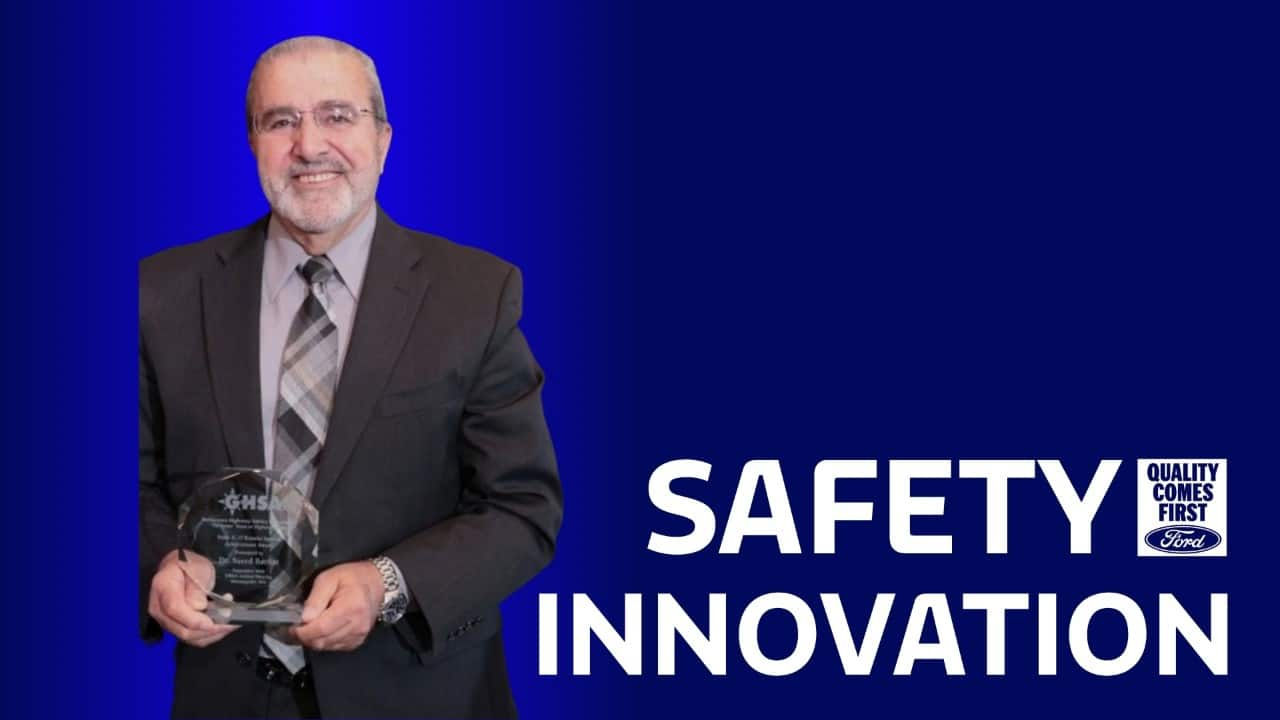
Many of the features we rely on to keep us safe in our vehicles today trace back to Saeed Barbat, Ph.D., executive technical lead for safety, policy, and vehicle analytical tools in the Ford Safety Office. 

Over his 35-year career, Barbat has advanced crash safety across a wide range of areas — from how vehicles absorb impact and protect occupants to how the human body responds to crashes and how different vehicle sizes interact in a collision. 

Barbat’s innovations include the blocker beam or equivalent structure that helps prevent smaller cars from sliding underneath the higher front-end of SUVs in a crash, seat belt airbags, and sensors behind driver-assist technology. 

“His innovations have helped improved real-world crash outcomes, support global safety standards, reduce development costs through virtual certification, and advance lifesaving technologies for conventional, electric, and autonomous vehicles,” according to the Governors Highway Safety Association (GHSA), which recently awarded Barbat the Peter K. O’Rourke Special Achievement Award.  

Barbat said he was honored and deeply humbled to receive the award. 

“I am particularly proud that some of my work was truly industry-first technology that was implemented in production vehicles and has demonstrated real-world benefits in reducing injuries and saving lives,” he said. “For me, that is the greatest reward: knowing that the work we do as safety professionals can make a real difference in people’s lives.” 

A Career Defined by Recognition 

Barbat holds Ford’s highest safety technical expert position worldwide. Since 2011, he’s overseen vehicle safety across the entire company — from early research to the rules that govern how vehicles are built. His work has been recognized with some of the highest honors in engineering, including election to the National Academy of Engineering in 2020, one of the most prestigious honors a scientist or engineer can receive. He is also a fellow in several major engineering societies. He holds 145 patents and has published nearly 75 technical papers. 

More Than 35 Years Making Vehicles Safer 

Here is a closer look at some of Barbat’s innovations: 

  • Aluminum-Intensive Vehicles: Barbat developed a way to accurately predict how aluminum — including its welds — would hold up in a crash, using computer simulations instead of costly physical crash tests. His simulation methods are now used industry-wide by crash safety engineers around the world. 

  • Blocker Beam: Barbat led the industry-first development and deployment of the blocker beam, a metal crash bar mounted under the front bumper of larger trucks and SUVs designed to prevent smaller passenger vehicles from sliding underneath them during a frontal collision. The innovation became an industry-wide safety standard and is credited with cutting real-world traffic deaths in those types of collisions by about 20%.
  • Head-Impact Modeling Technology: This technology helps predict and prevent head injuries in crashes — work that has saved lives and saved the auto industry hundreds of millions of dollars. 
  • Active-Passive Integrated Safety and Driver-Assist Technology: Barbat pioneered innovative industry-first integrated safety technologies research enabled by pre-crash sensors (radar and camera) that eventually evolved into the driver-assist features common in vehicles today (like automatic braking). 
  • Rear Inflatable Seat Belt: Barbat led the team that created the world’s first rear-seat inflatable seat belt — essentially an airbag built into the belt itself — which won several major innovation awards, including the 2011 Edison Award.

Click to Enlarge

An International Leader 

Beyond inventing things, Barbat has helped shape and publish international safety standards used around the world. He led the International Organization for Standardization's Working Group 4 on virtual testing, developing a worldwide standard that forms the basis for replacing physical testing with computer simulations. He also helped establish the modern total human body computer models researchers now use to study how the human body responds to crashes, paving the way for the current Vehicle Safety Virtual Certification effort. He also advises safety organizations across the United States, Europe, and China.

In addition, Barbat was the only safety leader from the entire U.S. automotive industry selected for a two-year National Academy of Engineering and Transportation Research Board consensus study on the road safety crisis. Published in September 2024 as the book, "Tackling the Road Safety Crisis: Saving Lives Through Research and Action," the study offers a lasting national road map for transportation and safety agencies to tackle the crisis.


QUALITY COMES FIRST