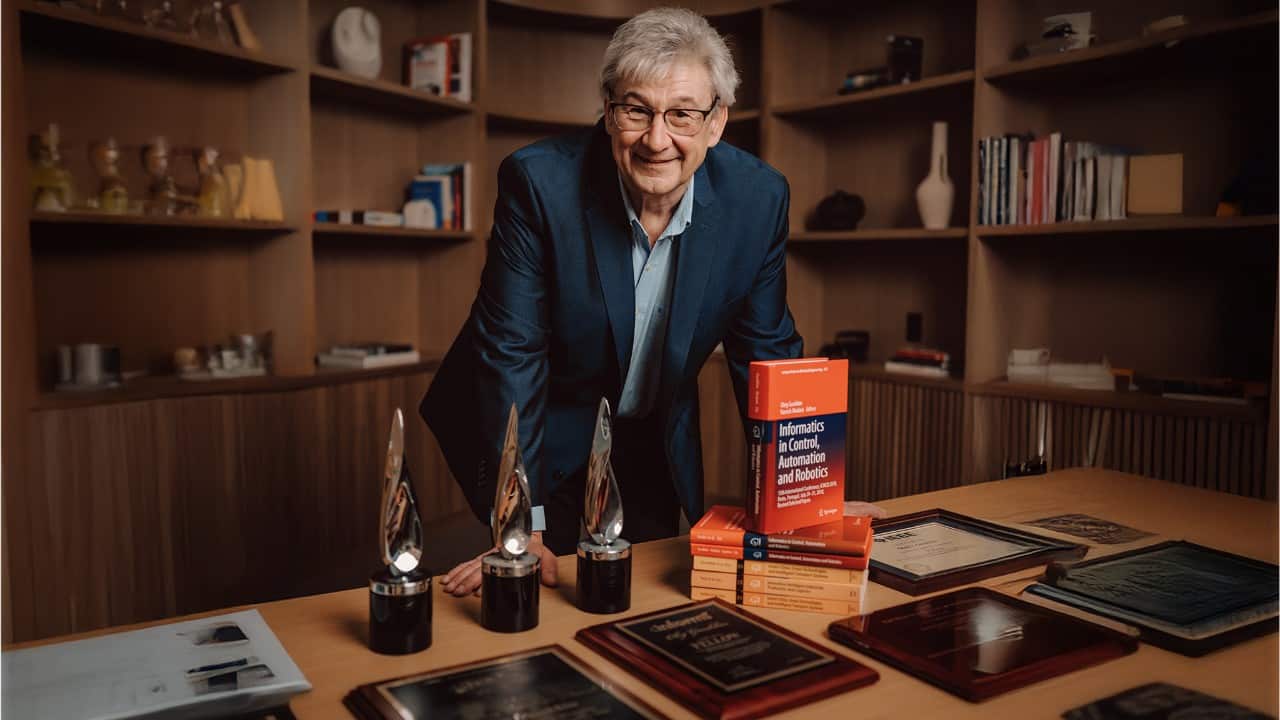
Gusikhin said his election to the NAE is more than a personal milestone.
“It signals that the work we do in GDI&A is now held to the same technical rigor as the chemical, safety, and control engineering that defined our first century, validating data as a high stakes engineering discipline in the automotive world,” he said.
Erica Klampfl, director, Industrial System Analytics, GDI&A, describes Gusikhin as “an inspiration to those who work with him.”
“His creativity in solving complex problems — especially when the path forward is unclear — is unmatched,” she said. “It is incredibly rewarding to see the NAE honor a pioneer from a nontraditional engineering background.”
Making an Impact
Gusikhin’s body of work has been dedicated to optimizing Ford's worldwide operations. In 2001, he and his team developed the e-workcell, which was essentially an early “digital twin” before the term was coined.
"Unlike traditional CAD tools, the e-workcell democratized analytics through intuitive, 3D game-like models," said Gusikhin. “This empowered assembly line operators to optimize their work cells and improve physical processes digitally, before any equipment was installed. It’s rewarding to see these foundational concepts evolve into today’s mainstream digital twin technology.”
Gusikhin’s career at Ford is marked by pioneering work that laid the groundwork for today's advanced technologies. He is the recipient of three Henry Ford Technology Awards spanning manufacturing, research, and product development, embodying Henry Ford's spirit of systems thinking.
- The Just-in-Time Execution and Distribution Information System (JEDI), developed in 2004, brought mathematical precision to Ford's factory floors by integrating data from various sources to provide actionable insights for scheduling and distribution. This "just-in-time" approach significantly reduced costs, improved workflow, and minimized inventory, generating over $20 million in savings within its first five years and remaining critical for managing components like those for the Ford F-150. Gusikhin notes that JEDI's longevity stems from focusing on the fundamental physics of material flow and deep collaboration with plant teams, fostering ownership and trust.
- Emotive Driver Advisory System (EDAS), developed in 2010, envisioned vehicles as connected, intelligent agents capable of interacting with the cloud to enhance the driver experience. This included optimizing the cabin and providing proactive safety alerts based on driver and vehicle states. This early research was foundational, evolving into the core of Ford’s software and services strategy and redefining mobility. Gusikhin himself describes EDAS as "the Model T of the digital era," pioneering the vehicle as a cyber-physical control platform.
- The Auto Air Refresh (AAR) system, recognized in 2021, utilizes advanced sensors and connectivity to continuously monitor both internal and external air quality. It then actively filters and refreshes the cabin air, effectively minimizing pollutants, allergens, and odors to ensure a healthier in-car environment.
“None of these achievements were solo efforts,” said Gusikhin. “I have been very fortunate throughout my 25 years to work with exceptional colleagues, visionary leaders, and world-class academic partners. These awards are a testament to the collaborative culture at Ford — a culture that started in the research labs and now flourishes within GDI&A, allowing us to turn data-driven insights into features that our customers love."
Leading Ford's Data Revolution