Search Enterprise or @FordOnline
Please remove special characters

‘My Other Generator is a Ranger PHEV’

Jun 29, 2026


DUNTON, UK – Did you know that Ranger PHEV with Pro Power Onboard is cleaner, cheaper and more convenient than a traditional petrol generator?

To prove it, Ford engineers took a typical petrol generator, rigged it up in the advanced emission test facility at Dunton and tested it across common scenarios to see how it stacked up against a Ranger PHEV with 6.9 kW Pro Power Onboard.

Kyle Shearer, segment chief engineer for Ranger in Europe, explains: “Not many portable generators work at the 6.9 kW that Pro Power Onboard offers; you tend to find portable units delivering around 4 kW, or bigger, more powerful setups built into trailers. We hired a common 4 kW portable generator, checked it over, and fitted a new exhaust to ensure it was in good condition and would connect to our testing systems. 
Click to Enlarge

“We then ran the generator at different loads to simulate common on-site use cases:

Low, around 300 W (recharging a power tool’s 12 V battery), medium, around 1500 W (using an oil-filled portable heater), high, around 2500 W (boiling a kettle), and very high, around 4000 W (keeping the oil-fired heater on during a tea break).

“Once we’d tested the generator’s emissions and fuel efficiency, we ran Ranger PHEV through the same tests for a fair comparison.”

The team measured four emissions types — nitrogen oxide, carbon monoxide, hydrocarbons and carbon dioxide (CO2). 

At low power levels, the generator emitted around 15 times more nitrogen oxide than Pro Power Onboard, rising very sharply to over 9,000 times more at very high power levels. Ranger PHEV’s nitrogen oxide emissions actually dropped to nothing as the anti-emissions systems worked harder when drawing more power. 

The test also showed that the generator produced over 450 times more carbon monoxide than the Ranger PHEV, with a peak difference of over 1200 times more at very high power output. 

It was a similar result when testing for hydrocarbons. Compared to Ranger PHEV using Pro Power Onboard, a site generator again produces anywhere from 15 to over 110 times more hydrocarbons for the same power output.

So, what about CO2? From a cold start, the Ranger PHEV emitted more CO2 than the generator for the same power output. However, within five minutes the engine and exhaust systems were up to temperature and from then, as soon as you need over 2 kW of power, the generator produced more CO2.

Kyle adds: “Although the petrol engine in Ranger PHEV is larger than the generator’s, it actually uses less fuel. With Pro Power Onboard engaged, Ranger PHEV’s computers automatically trigger the petrol engine when needed to recharge the battery or maintain it at a constant charge level.

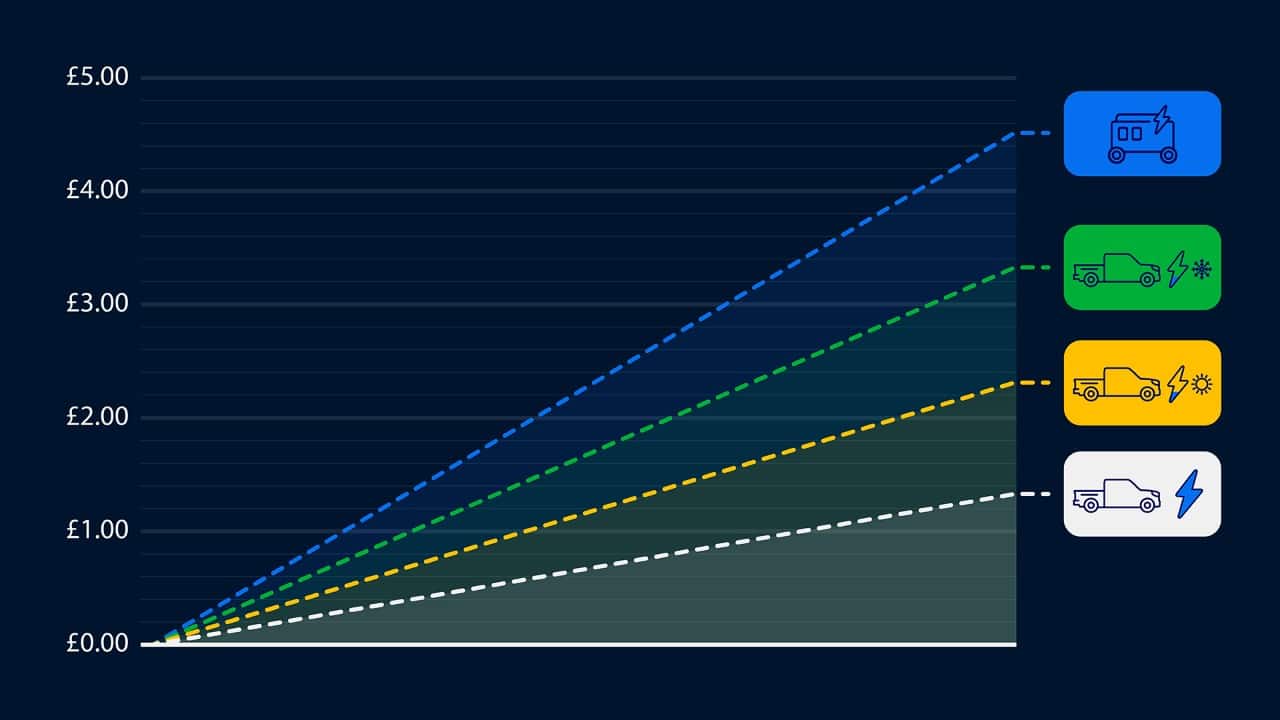
“Even if you have an empty battery and start Ranger PHEV’s engine from cold, running Pro Power Onboard is more efficient. With Ranger PHEV up to temperature, Pro Power Onboard uses half as much fuel as the generator — and once the engine only switches on to maintain the battery level, your fuel cost becomes just one-third that of the generator.