As Ford China’s export business flourishes, an increasing number of China-built models are making their way onto the global stage. In this ambitious journey of international expansion, while front-end sales act as the spearhead, a robust after-sales service network serves as the essential backbone.
Whether a vehicle truly wins a reputation overseas depends heavily on the customer's experience after the purchase: Is the maintenance expensive? Is the wait time too long? Is there someone to solve problems when they arise?
Click to Enlarge
Charles Liu - JMC Export SEO Manager, 2025 Ford China Employee of the Year
This is precisely why Charles Liu and his Export Upstream Program (EUP) team exist. Their mission is not to "put out fires" after they start, but to identify all potential "ignition sources" in advance. By smoothing the path before a vehicle even hits the market, they ensure that every exported car receives proper care, even on the other side of the world.
A Battery Pack and a Costly Dilemma
The story began with a quotation from a battery supplier.
In the domestic Chinese market, the battery service follows a mature model: if a battery has an issue, the supplier’s engineers go on-site to perform precise repairs or replacements. However, this logic fails when applied to exports.
When suppliers set domestic prices, they calculate based on local freight and parts costs. Once a vehicle is exported, labor costs for repairs can be several times higher than in China, and original quotes simply cannot cover the actual cost. In response, the supplier’s proposed solution was straightforward:
For every exported battery pack, Ford would pay an additional RMB 100 per kilowatt-hour.
For a 55-kWh battery pack, that meant an extra RMB 5,500 per vehicle. Applied across total export volume for a vehicle line, and then multiplied over its full lifecycle sales, the number became staggering. Even though battery quality issues were extremely rare, adding that cost to every single battery pack would significantly weaken the product’s competitiveness in local markets.
Even more challenging was the supplier’s "overseas solution": a mandatory full-pack replacement. Even if only a minor component failed, the entire pack had to be swapped. This meant not only exorbitant costs but also grueling wait times—in some markets, it could take a full month for a new battery pack to arrive.
For Charles and his team, the visible economic and time costs were just the tip of the iceberg. Deeper concerns lay in two major "uncertainties":
Click to Enlarge
1. An Incomplete Service Framework: As the supplier was also in the exploratory phase of international business, their global repair network was incomplete. Response speed relied heavily on local infrastructure, making actual execution difficult to verify.
2. Long-term Cost of Ownership: Once the power battery exceeds its warranty, a "replacement-only" model is a heavy burden for users. A minor fault shouldn't force a consumer to face the massive expense of a full battery replacement. If this inefficient model remained unchanged, the brand's hard-earned reputation could easily falter at the after-sales stage.
Not An Ordinary Battery
Charles and his team reached a clear conclusion: since the supplier’s overseas plan was unsatisfactory in both cost and efficiency, Ford needed to find a way to repair the battery itself.
Click to Enlarge
The challenge was that this battery was not designed for ordinary technicians to service.
Unlike many standardized, high-volume battery packs, its internal high-voltage structure required repair personnel with specialized qualifications. Most dealerships lack technicians with these specific qualifications, and it is impractical to station a high-voltage specialist at every single outlet for low-probability events.
Furthermore, to develop repair manuals and train technicians on assembly, the team needed detailed drawings of the battery's internal structure—information that often comes with additional costs.
At a critical juncture, internal doubts surfaced. Some decision-makers leaned toward "accepting the supplier’s plan and paying the overseas service fee" to move forward quickly.
But the team didn't give up. In March 2025, they organized a comprehensive gap analysis. They visited various battery suppliers one by one, laying out the reality and long-term costs. Ultimately, they convinced leadership: they had to forge a new path.
“Flying Doctors”: A Practical Solution Under Tight Constraints
Click to Enlarge
The final solution came with a vivid name: the “Flying Doctor”.
The core logic of this model is efficiency: instead of requiring every dealer to have high-voltage engineers, Ford trains and deploys a small number of Flying Service Engineers with advanced electrical certifications in key overseas markets. When a battery fault occurs at a dealership, the "Flying Doctor" travels to the site with specialized tools and parts to complete the repair right in the shop.
Regarding technical data, a compromise was reached: the supplier provided screenshots of key structures rather than raw data files. These screenshots were sufficient for the team to create schematic diagrams, allowing the repair manuals to be finalized and secured through contract terms.
Click to Enlarge
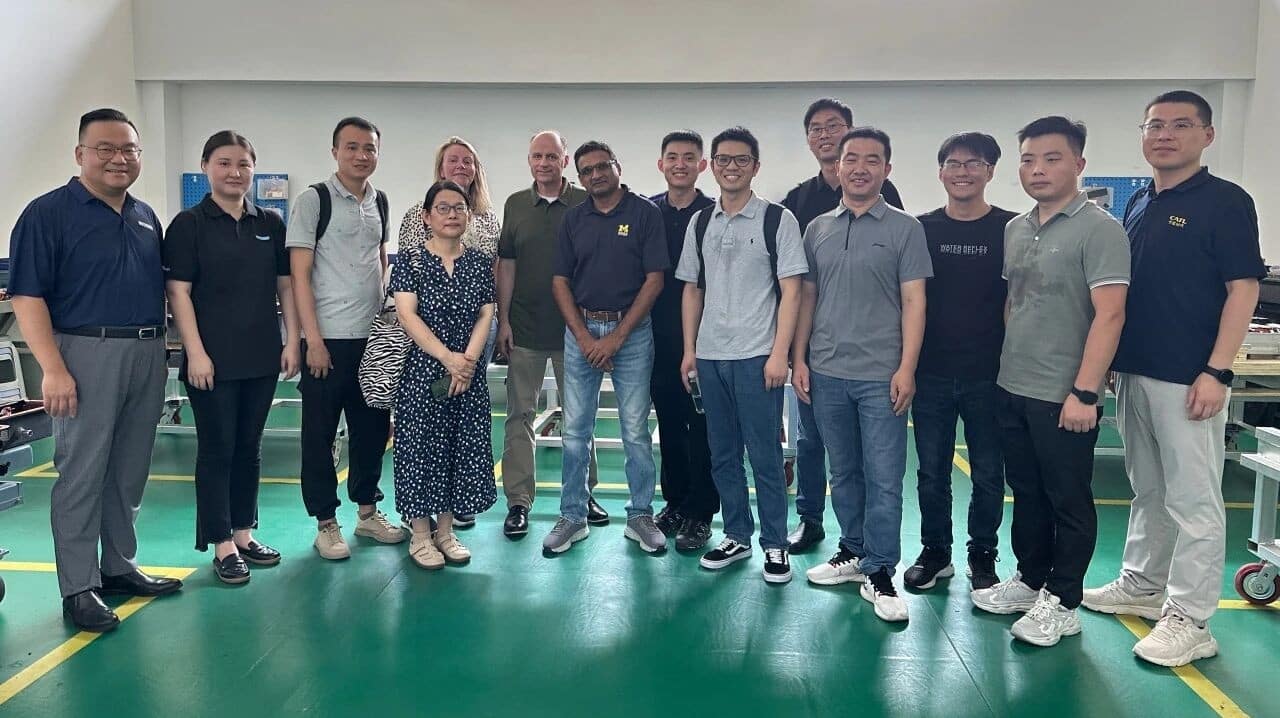
Charles (the 6th from right) and the team visit battery supplier
30 Days vs. 3 Days: The Power of Efficiency
The results were tangible.
With the "Flying Doctor" model in place, customer wait times were slashed from several weeks or a month to approximately three days. The "doctors" perform precision repairs rather than replacing the entire pack by default.
On the financial front, the supplier ultimately agreed to supply parts at the same price as in the domestic market, waving the overseas service surcharge. Based on the planned sales volume of the relevant models, this change is expected to result in a total cost saving of approximately $140 million USD.
For consumers, this significantly lowers the cost of ownership. Instead of facing a potentially astronomical bill for a full battery replacement, they now benefit from a "diagnosis and treatment" approach that is both faster and more affordable.
More Than Just Batteries: A New Way of Working
Charles says that the team often refers to their work as "Upstream Service Engineering." Their role is preventative; while a vehicle is still in development and hasn't left the factory, they identify every possible after-sales hurdle. They push the engineering and supply chains to "embed" solutions into the design phase.
"The cost of a post-launch fix is too high. Some problems are impossible to change once the car is on the market. Instead of being led by the nose later, it’s better to pave the way now," Charles explains.
Click to Enlarge
Ford Export Upstream Program Team
This team coordinates with market partners across multiple time zones, including Europe, South America, Mexico, Southeast Asia, and Australia. Much of their work only becomes visible through the "absence" of problems once the car is launched—a form of silent value.
"It’s quite fulfilling," Charles says. "When we see overseas media or customers saying we’ve brought a great product to their market, we know the effort was worth it." In recognition of this achievement, Charles has been honored with the 2025 Ford China President's Award (Employee of the Year).
Today, the "Flying Doctor" model has become a competitive advantage for Ford China’s exports, now being replicated in other negotiations. As Ford moves further into the global market, it is this group of "behind-the-scenes navigators" ensuring that the journey for China-built vehicles is steady, successful, and long-lasting.