Search Enterprise or @FordOnline
Please remove special characters

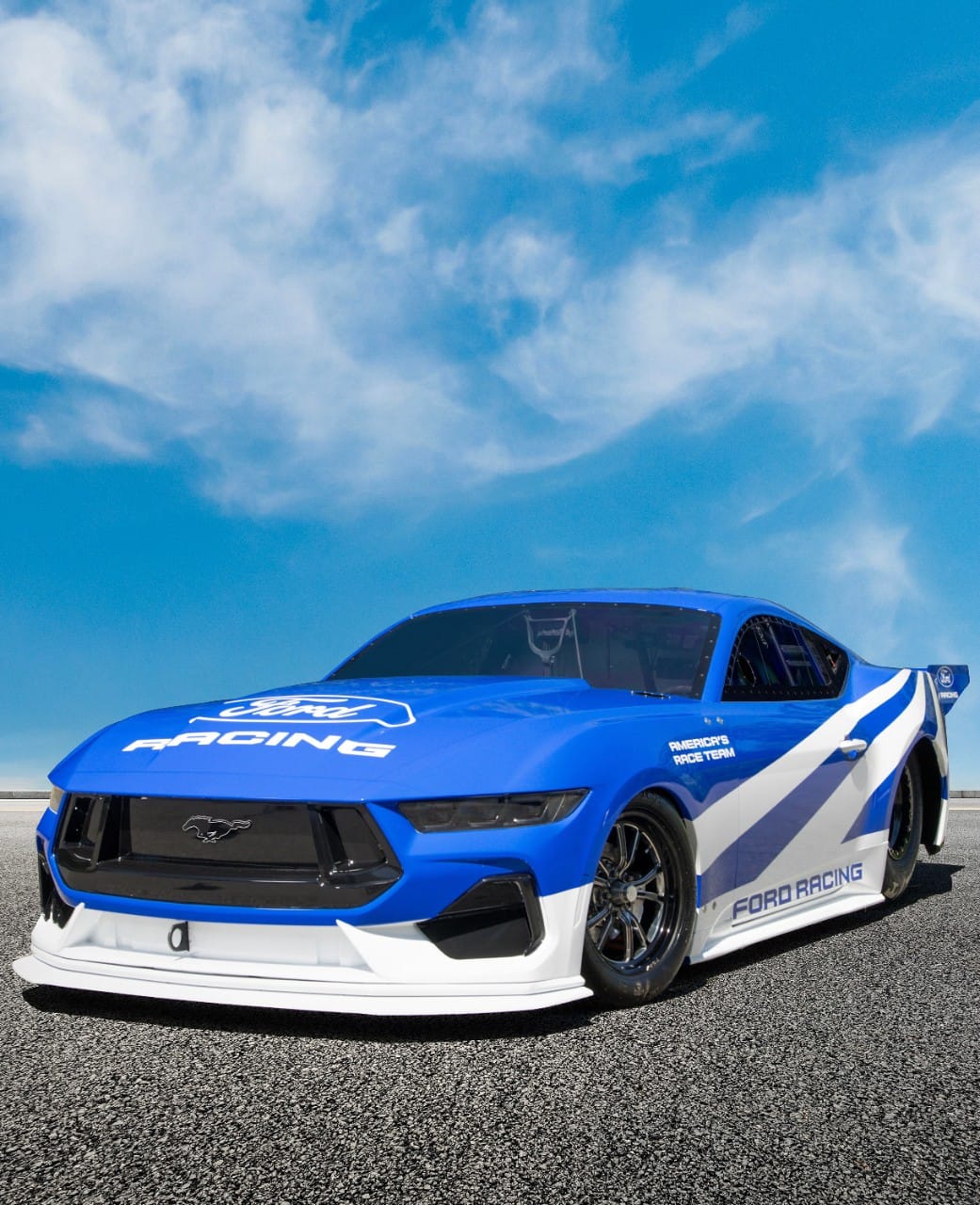
Inside the Breakthrough of Cobra Jet 2200, the Fastest Electric Car in the Quarter Mile

Apr 28, 2026

When you bring a car like the Ford Racing Mustang Cobra Jet 2200 to the racetrack, there is a moment when the work stops being theoretical. The calculations are done. The build is done. The engineering reviews are done. At that point, the car has to do what it was built to do. There is only 1,320 feet between the starting line and a new world record.

That is why the National Hot Rod Association (NHRA) Charlotte was such an important moment for us at Ford Racing.

This was our opportunity to put Cobra Jet 2200 in front of fans, racers, media, and the broader performance community to show what this program is capable of in the environment where it matters most. We came out of the weekend with official results that we are incredibly proud of: a low ET of 6.76 and a top speed of 222 mph in the quarter mile, making us the quickest and fastest electric car in the quarter mile. 

More importantly, we came away with exactly what a program like this is supposed to deliver: proof of concept, real-world learning, and a clearer understanding of what the future of performance can look like at Ford Racing.

For me, Charlotte was a culmination — and a starting point. It was seeing years of work and progression come into focus, with the door open to go further, faster.

Cobra Jet 2200 is part of a larger Ford Racing story. Before this vehicle, there was the Cobra Jet 1400. Then there was the Super Cobra Jet 1800. Both programs helped push our understanding of what electric drag racing could be through the Ford lens. They challenged us to think differently about power delivery, battery performance, calibration, traction, and how to package extreme electric performance in a way that could actually perform on the drag strip.

Cobra Jet 2200 is the next step in that progression.

What makes this vehicle important is that it reflects a deeper evolution in how we think about EV performance. This is a purpose-built electric drag car created to answer very specific engineering questions at a very high level. What happens when you pursue maximum performance with an electric platform designed for this environment? How do you manage power, traction, serviceability, and safety in a package that has to perform repeatedly under extreme load? How do you take everything you have learned and apply it with precision?

To answer, the whole Cobra Jet 2200 system works in three critical steps that have seen incredible engineering developments from our team.

1. Weight Reduction

A core mission for Cobra Jet 2200 was to shed every pound in pursuit of performance. This can be seen in the world-class power density from two 1,200hp electric motors, a custom tubeframe chassis, carbon-fiber body, even down to a NASCAR-style vinyl wrap (20 pounds lighter than a standard vinyl!). 

Peak output always gets attention, and it should, but the bigger story is how much capability the team was able to package into a highly optimized drag racing system. Cobra Jet 2200 is over 900 pounds lighter than the Super Cobra Jet 1800, which was 1,000 pounds lighter than the Cobra Jet 1400. This is the result of pushing for maximum output, reduced mass, and greater efficiency at the same time. Cobra Jet 2200 represents a major step forward in how much performance can be extracted from an EV package purpose-built for this environment.

2. A Drag Racing-Derived Driveline to Handle the Power

Cobra Jet 2200 delivers 2,200 horsepower to the wheels, but that is only half of the story. With 1,340 ft-lbs of torque on tap, the next challenge is making it usable and delivering it in a way that the tire and surface can accept. The Reverse-Acting Centrifugal Clutch (RACC) paired with a 5-speed clutchless transmission helps manage how power is applied to the track. Our team developed the patented RACC that allows the car to launch in direct drive and then slip during shifts to help prevent tire slip and keep the car controlled as the run develops. It is a critical bridge between raw capability and real performance.

Behind the a-pillar, you could be mistaken into thinking that this is a gas-powered drag car based on the transmission, driveshaft and rear end coming right out of a drag racer's parts bin. This was not a compromise, but the result of racers perfecting their craft over 70 years of competition. From an engineering perspective, these components allow us to maximize efficiency and power to the ground throughout the run. No need to reinvent a well-honed wheel. While most EV's make do with one or two gears, we shift through five to ensure we are achieving the maximum torque at the wheel at every second in the run.

3. A Robust Safety System Leveraging Pyrofuse Technology

The final piece is protection. In a high-voltage race car operating at this level, safety has to be built into the system from the beginning. A pyrotechnic circuit breaker (pyrofuse) is a key part of our strategy. It helps isolate the high-voltage system when needed and is engineered to support safe operation in a true racing environment. It does this by physically breaking the high-voltage circuit with a small detonation. It also helps that pyrofuses are lighter and faster-acting than their melting-fuse counterparts. Our team collaborated with the NHRA to develop a cut loop system that allows for safety workers to activate the pyrofuse from outside the vehicle to ensure safety in all situations. It is not separate from performance. It is part of the total system. When you are running at this level, safety, control, and power all have to work together.

That, to me, is what makes Cobra Jet 2200 so compelling. The ET and speed are impressive. But to solve the challenge in the right order - create extraordinary power density, develop the driveline control to manage it, and build the protection needed to run it safely at the highest level - is a seriously complicated puzzle of engineering ingenuity. Especially because in a drag car, everything is compressed into a few seconds and 150 revolutions of the rear tire, which means every decision gets exposed very quickly.

That is one of the reasons racing has remained such a powerful proving ground for us at Ford for 125 years as America’s Race Team.

Motorsports has long been one of the clearest ways to accelerate development because it concentrates effort around a hard target. It forces clarity. It reveals strengths. It reveals weaknesses. It pushes engineering teams to solve real problems with real consequences. A racing environment does not let you hide behind theory for very long. You either perform, or you learn exactly what needs to improve.

Click to Enlarge

That has always been part of Ford’s racing DNA, and it remains true here. Cobra Jet 2200 is a demonstration of speed, yes. It’s also a demonstration of capability, of intent, and of a mindset that says innovation should be tested where the standard is high and the outcome is measurable.

The official results from the event matter, and we are proud of what the team achieved. But what excites me just as much is what comes next. Every pass of the Mustang Cobra Jet 2200 gives us information and adds to our understanding. Every milestone creates a new target. That is how serious racing programs evolve, and that is how meaningful technical progress happens to make better products for our customers.

The timeslip tells one part of the story.

What we learn from it tells the rest.