Search Enterprise or @FordOnline
Please remove special characters

In this Facility, the Storm Is the Proving Ground

Mar 27, 2026


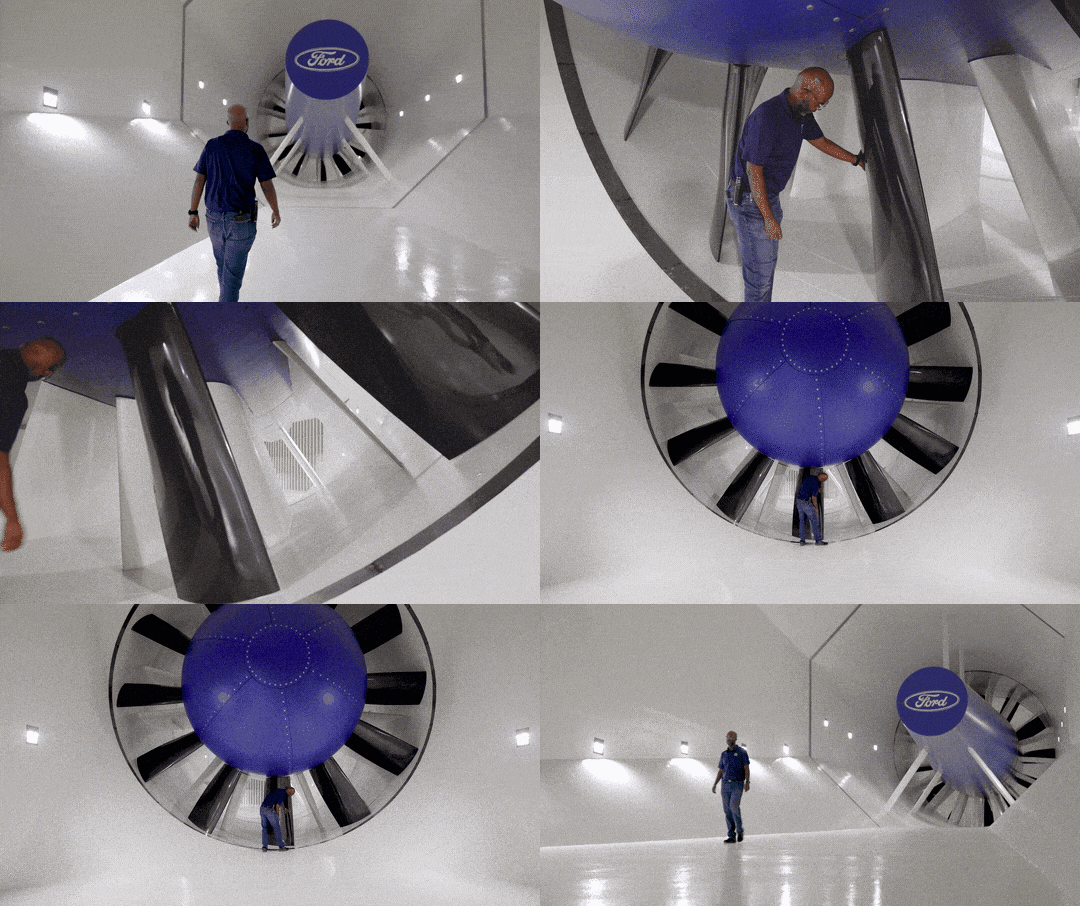
I am 5’2”. Usually, that means I’m looking up at most things in the world, but the second I stepped into the Ford Rolling Road Wind Tunnel, I felt like a tiny Lego figure.

If you look at the photo of me standing in front of the main fan, you’ll see exactly what I mean. That fan is a staggering 26 feet wide, and each of its carbon fiber blades is 5.5 feet long. That means a single blade is taller than I am.

I recently spent time with the experts who run this facility to see how Ford uses this massive space to improve vehicle quality. I came out realizing that this state-of-the-art facility is one of Ford’s most powerful tools for ensuring that every vehicle we assemble is ready for both the road and racetrack. By capturing precise aerodynamic data, we can validate exactly how a vehicle will perform, long before it ever reaches your driveway.

Click to Enlarge

The Moving Road and the F-150 Tremor 

In order to get accurate data, you have to try to recreate the natural environment. When you’re driving on the highway, the ground is moving under you. That movement changes how air flows under the truck and around the tires. If the truck is just sitting on a flat, still floor while the wind blows, the data isn't as accurate as it could be.

To solve this, the facility uses a 5-belt moving ground plane. Think of it as five massive industrial treadmills — one under each tire and one huge belt running down the center of the vehicle. This allows the Ford team to see exactly how the air behaves at high speeds while the truck stays perfectly still.

The team from The Fast Lane Truck (TFLtruck) recently came out to see this in action with a new F-150 Tremor. You can see the facility (and that massive fan) in motion and their experience in this TFLtruck story and video. They got to see firsthand how the moving ground plane is used to ensure the truck handles the wind with precision. Watching a 5,000-pound truck “driving” at highway speeds while stationary is pretty cool.

Precision Down to the Tires 

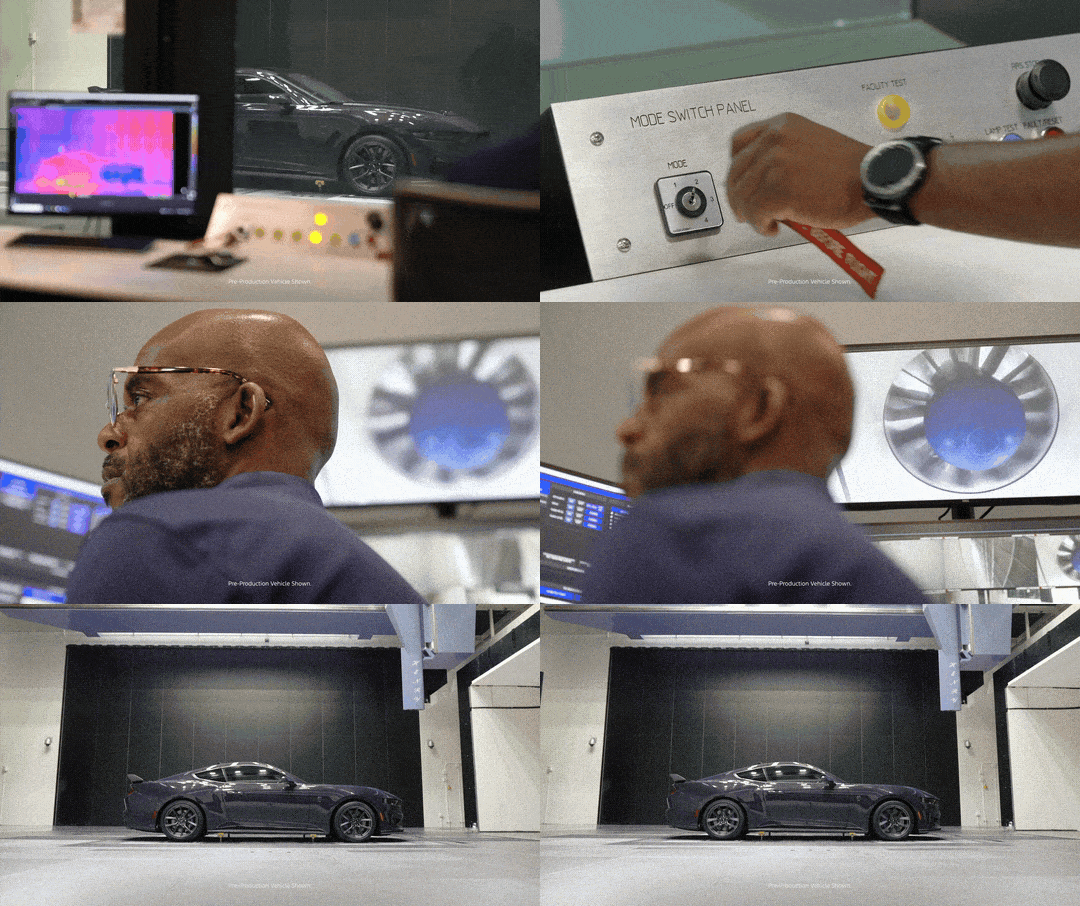
The plan for the day was focused on tire validation, which is a perfect example of the level of detail required for quality testing. The engineers were conducting a study to ensure that an alternate tire design still met the vehicle's strict aerodynamic standards compared to the current production tire. In a facility this precise, you can actually verify how a specific tread pattern affects the way air moves through the wheel wells and under the chassis.

This data is vital because a tire doesn't just grip the road; it dictates how air is managed as it flows around the vehicle. By running these side-by-side tests, Ford validates that any component change — even one as seemingly small as a tire — maintains the quality and performance standards set for the vehicle.


Mind-Blowing Stats

Here are the facts that demonstrate how powerful this place is: 

  • The Power of 4,000 Homes: At top speed, the fan uses 5.4 megawatts of power. To put that in perspective, that’s enough energy to power roughly 4,000 to 5,000 homes at the same time! All that energy is focused on making sure the testing is as accurate as possible — and helping save energy when a vehicle is moving against wind on the road or a race track.
  • Two Ways to Blow the Wind: The nozzle of the wind tunnel can actually change its area. There is a large nozzle setting that goes up to 155 mph for production vehicles like the F-150. But there is also a small nozzle setting that can reach a blistering 200 mph used for motorsports.
  • A "Noise-Canceling" Building: The facility has seven "Helmholtz resonators" built into it. If you’ve ever blown across the top of a glass bottle and heard that deep hum, that’s a resonance. In a huge tunnel, the building itself can make those sounds, which would mess up the data. These resonators basically act like giant noise-canceling headphones for the test section, soaking up those extra vibrations, ensuring the wind moving over and under the vehicle is of optimal quality.
  • Meet Henry and Clara: The team even has names for the equipment. Henry and Clara are two massive robotic arms that can hold 40% scale models of vehicles. They use them to study "tandem" driving — like what happens when you’re passing another vehicle on the highway. It helps us understand how vehicles interact with each other in the real world, like when you feel that slight "pull" as you pass a semi-truck. 
  • Speedy Changes: Even though the equipment is massive, the team can swap the entire 5-belt ground plane system for a single-belt system in just four hours. This allows them to be efficient and test many different scenarios in a single day without wasting time.
Click to Enlarge

Why Wind Tunnels Don't Compete

This was probably the most surprising thing I learned: In the world of aerodynamics, automakers actually work together.

The engineers told me their mantra is: “The vehicles compete, not the wind tunnels.” 

Even though Ford invested $140 million in this facility, it’s part of a global community of scientists. Last year, Ford actually tested vehicles at four different competitor wind tunnels as part of a study — and those other companies came and tested at ours, too!

Engineers from different companies meet regularly to discuss safety, share the best ways to run tests, and they even co-publish scientific papers together. They believe that when it comes to the science of wind and safety, everyone should work together to make sure the data is as accurate as possible. By sharing what they learn, they help push the entire industry to be better. It’s a collaborative approach to quality that I found really inspiring.

Bringing the Road Inside

At the end of the day, all these massive numbers — the 26-foot fan, the 200 mph speeds, and the power of 4,000 homes — are all about one thing: validation. 

Ford uses this facility to help prove that the engineering behind every vehicle is aerodynamically efficient. Whether it’s spending the afternoon obsessing over how air moves around a specific tire or using Henry and Clara to study how trucks behave when passing each other, the goal is to help ensure that every Ford is built to handle the real world.

I may be a Lego figure compared to that fan, but I’m so impressed by the work the wind tunnel team does to back up the Ford quality promise. It’s a reminder that quality isn't just about what you can see on the surface — it's about the invisible work happening in the wind.


Dawn McKenzie is truck communications manager at Ford.