


点击链接,阅读中文版:《5年增长10倍,凭什么?》
Search Enterprise or @FordOnline
Popular Terms & Topics:
Popular Tools & Resources:
10x Growth in 5 Years: The Strategy Behind the Ford Territory’s Global Expansion
Mar 07, 2026

In 2025, Ford China’s export volume reached 184,000 units, a 9% year-on-year increase.
Leading this charge was the Ford Territory, which saw exports surge 28% to 95,000 units.
The Territory’s trajectory—from 9,200 units in 2020 to 95,000 today—covers over 80 markets worldwide, mmaking it one of Ford’s most profitable global models.
More than just a successful export...
The Territory has become a mobile "laboratory," redefining the boundaries of quality by adapting to the world’s most complex geographical and cultural landscapes.
The Ford Territory (and its domestic counterpart, the Ford Equator Sport) is produced at JMC’s Fushan plant in Nanchang, Jiangxi. This facility features a high-performance SUV welding line with a 98% automation rate, powered by 380 precision robots.

The assembly shop integrates nine AI vision inspection systems covering over 2,800 parts. These systems act as an infallible gatekeeper, detecting missing components, color mismatches, or misalignments in real-time, ensuring that no defect leaves the line.
Beyond hardware, conversations with Ford’s product planning and quality experts—including Eric Yu, Michael Wang, Kim Jin, and Haibin Li—reveal three "hardcore" pillars behind the Territory’s success: market penetration, technical resilience, and data-driven trust.

01. From Product Export to Value Chain Integration

The Territory’s globalization has evolved from "testing the waters" to deep systemic integration.
While it has already secured a foothold in South America, the Middle East (where it was named 2024 Arab Car of the Year), and ASEAN, the real story lies in the diversification of its export model.
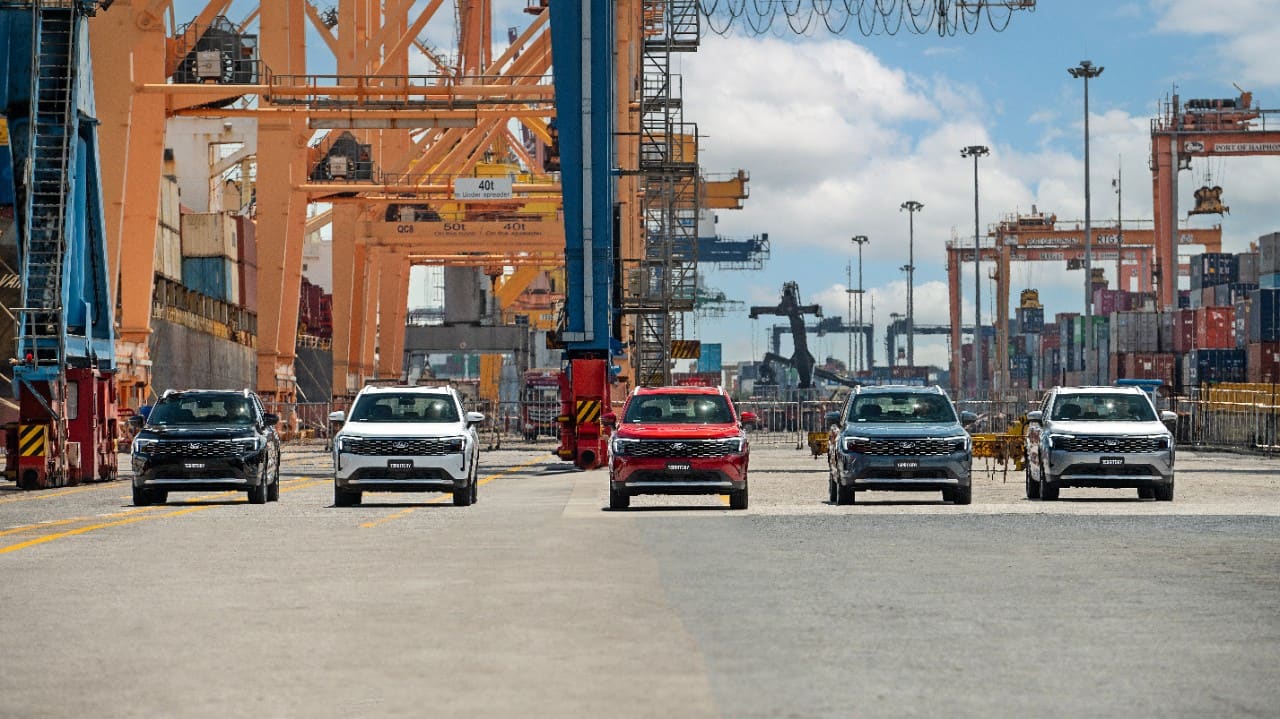
Media Test Drive in Vietnam
Ford has moved beyond CBU (Completely Built Up) exports to CKD (Completely Knocked Down) assembly in core markets. In Taiwan, for instance, local assembly via Ford Lio Ho is expected to push annual sales past 10,000 units.
This "industrial standard export" optimizes tax structures but demands "atomic-level" quality control for parts. Following successes in Vietnam and Cambodia, CKD operations are now scaling in Indonesia and Malaysia.
02. "Detective" Engineering: Solving Real-World Puzzles

While traditional laboratory testing and rigorous calibration protocols are sufficient to cover the vast majority of predictable driving scenarios.
The operational reality of exporting to over 80 distinct countries introduces a chaotic array of environmental and cultural variables that frequently present challenges far beyond the scope of any standard engineering manual.
- The Lima "Idle" Mystery: In Lima, Peru—one of the world’s most congested cities—customers reported unusual oil consumption. Lab simulations failed to replicate the issue until the Project Vehicle Team (PVT) went on-site. They discovered that due to extreme traffic, the engine’s operating hours were 3 to 4 times higher than the mileage suggested. Ford responded by re-engineering the piston rings with a three-piece oil scraper to handle prolonged idling.
- The Philippine "Mud" Challenge: In the Philippines, narrow roads often force drivers to dip their right wheels into deep mud. Moisture-heavy debris caused felt liners to detach under the added weight. The team solved this by increasing the density of dustproof and waterproof materials specifically for the region.

03. System Stability in Complex Environments

With the launch of the FHEV (Full Hybrid Electric Vehicle) version, quality control moved from individual components to systemic stability. In South America and Southeast Asia, where charging infrastructure is limited, FHEV demand has skyrocketed.
To ensure reliability, the team adopted a "One Country, One Policy" strategy.
For markets like Vietnam and Cambodia, where fuel contains high levels of sulfur and phosphorus, Ford added external fuel filters and recalibrated electronic control strategies. This localized engineering ensured the FHEV system could bridge the gap between varying global fuel standards.
04. "Rapid Hub": Leveraging the 45-Day Shipping Window

While ensuring hardware robustness is the essential baseline, it is ultimately just the first step; to successfully eliminate the lag between consumer experiences in global markets and the engineering teams at the factory, Ford established 'Rapid Hub,' a dynamic, closed-loop data system that revolutionizes response times.

The logic is ingenious: It takes 30 to 45 days for a vehicle to travel from Shanghai to a destination port. Rapid Hub utilizes this "dead time." If port-of-entry inspections (PDI) detect a recurring minor issue, the R&D center initiates a solution immediately. By the time the ship docks, a software patch or inspection guide is already waiting for the local technicians.
This "fixed before arrival" efficiency reduces the quality stabilization period for new models to just three months. Furthermore, every vehicle’s "digital birth certificate" at the Fushan plant allows engineers to trace the torque of a single bolt or a glue path via the VIN, enabling surgical root-cause analysis.
05. The Human Spine of Quality
Behind the automated lines and data links are the people bridging the gap between cultures. Over 60 Ford specialists live "dual-city" lives, commuting between Nanjing, Shanghai, Taipei, and Nanchang.
They serve as "translators" between Ford and JMC corporate cultures. By replacing skepticism with trust through face-to-face workshops and shared grit, they provide the invisible "spine" of the quality system.

The Territory’s success is more than a sales victory; it is a profound evolution of the "Made in China" quality system, proving that Ford China is ready to lead on the global stage. Looking ahead, this blueprint is already being applied to the next generation of EV, EREV, and Hybrid models.
